


In this article:
A procurement-focused comparison of the two dominant para-aramid brands — tensile data, ballistic certification, pricing, and supply chain realities.
In any Kevlar vs Twaron procurement decision, the wrong choice costs you more than the fiber itself. Failed ballistic certification, delayed production lines, and customs disputes over IP-protected brand names are real risks when you pick a para-aramid brand without understanding the actual differences.
Procurement managers evaluating what is aramid fiber often encounter both brands in supplier quotations. The question is not which fiber is “better” — it is which one fits your application, your budget, and your import logistics without creating downstream problems.
Kevlar and Twaron are the two dominant para-aramid fiber brands, both based on poly-paraphenylene terephthalamide (PPTA) polymer chemistry, produced respectively by DuPont and Teijin, with near-identical tensile performance but differences in filament geometry, supply chain geography, and commercial licensing terms. This Kevlar vs Twaron comparison breaks down those differences so you can make a sourcing decision backed by real data, not marketing claims.
What Kevlar and Twaron Actually Are
Kevlar was developed by DuPont in 1965 and commercially launched in 1971. Stephanie Kwolek’s discovery of PPTA (poly-paraphenylene terephthalamide) spun from a sulfuric acid solution created a fiber with tensile strength five times that of steel on an equal-weight basis. DuPont manufactures Kevlar primarily at its Richmond, Virginia facility, with Kevlar 29 (ballistic grade) and Kevlar 49 (composite/structural grade) being the two most commonly sourced variants.
Twaron entered the market in 1976 through Akzo Nobel (now Teijin Aramid, headquartered in Arnhem, Netherlands). Teijin produces Twaron at its Emmen facility in the Netherlands, with Twaron 1000 (standard ballistic grade) and Twaron 2200 (high-modulus composite grade) as the primary commercial grades. Teijin also operates production in Japan, giving Twaron a dual-origin supply footprint.
Both fibers share the same PPTA polymer backbone. The molecular chain is rigid, rod-like, and aligned through a wet-spinning process that creates highly oriented crystalline domains. This shared chemistry is why tensile and thermal properties are so close — the differences emerge from filament surface treatment, spin-finish chemistry, and post-draw ratios that vary between the two manufacturers’ proprietary processes.
The practical implication for buyers: when your aramid fiber specifications call for PPTA para-aramid, you are specifying the polymer class, not the brand. Kevlar and Twaron both satisfy that class requirement. Your choice between them is a commercial and logistical decision, not a fundamental materials decision.
Core Properties: Tensile Strength, Modulus, Density, and Heat Resistance
The most common procurement question is: “Is Twaron as strong as Kevlar?” The short answer is yes — within the margin of measurement variability. The longer answer requires looking at specific grades and test conditions, because tensile performance varies by denier, twist level, and moisture conditioning.
Below is a property comparison for the standard ballistic-grade variants most commonly sourced by protective equipment manufacturers. All values are measured per ASTM D7269 and ISO 13934-1 standards on conditioned filament yarns.
| Property | Kevlar 29 | Twaron 1000 | Difference |
|---|---|---|---|
| Tenacity (cN/dtex) | 20.5 – 21.0 | 20.0 – 21.0 | < 2.5% (negligible) |
| Tensile Modulus (GPa) | 70 – 83 | 70 – 80 | ~3% (Kevlar slightly higher) |
| Elongation at Break (%) | 3.5 – 4.0 | 3.3 – 3.7 | Twaron slightly lower |
| Density (g/cm³) | 1.44 | 1.44 | Identical |
| Long-term Heat Resistance | Stable to 180°C | Stable to 180°C | Same thermal ceiling |
| Decomposition Temp | ~450°C | ~500°C | Twaron marginally higher |
| Filament Friction Coeff. | 0.25 – 0.30 | 0.20 – 0.25 | Twaron lower (easier weaving) |
| Moisture Regain (%) | 4.5 – 7.0 | 4.5 – 7.0 | Same range |
The key takeaway from this table: for ballistic applications, tensile tenacity and density are functionally identical. The 3% modulus advantage of Kevlar 49 over Twaron 2200 matters in aerospace composites but is irrelevant for soft body armor. Where a measurable difference exists is filament friction — Twaron’s lower coefficient translates to fewer needle breaks during weaving, which reduces production waste and improves weaving speed on multi-axial machines.
Ballistic Performance: NIJ 0101.06 Certification Differences
Both Kevlar 29 and Twaron 1000 meet the NIJ 0101.06 standard for Level II and Level IIIA soft body armor when woven into appropriate panel constructions. The certification is granted to the finished vest panel, not to the raw fiber — so the fiber brand itself does not appear on the NIJ certificate.
What determines ballistic performance is the fabric architecture: GSM (grams per square meter), weave type (plain, twill, or UD unidirectional), ply count, and panel layer stacking sequence. A vest made from 10 layers of 200 gsm plain-weave Kevlar fabric performs the same as 10 layers of 200 gsm plain-weave Twaron fabric with identical construction parameters. This has been verified in independent testing at HP White Laboratory and OBL (Ordin Balistic Laboratory).
However, a practical certification nuance exists. DuPont provides pre-certified fabric construction specifications for Kevlar — published construction sheets that tell the vest manufacturer exactly how many layers, at what gsm, with which weave, will achieve NIJ IIIA compliance. Teijin provides equivalent construction guidance for Twaron, but the documentation format and layer specifications differ. If your vest factory is accustomed to DuPont’s construction sheets, switching to Twaron requires recalibrating the layup schedule — not because the fiber is different, but because the construction guidance follows a different format.
Pricing, Availability, and Supply Chain Considerations
Pricing differences between Kevlar and Twaron are not driven by fiber performance — they are driven by origin geography, import logistics, and brand licensing terms.
| Factor | Kevlar (DuPont) | Twaron (Teijin) |
|---|---|---|
| Primary Origin | USA (Richmond, VA) | Netherlands (Emmen) + Japan |
| FOB Pricing (1500D yarn) | $48 – $65/kg | $42 – $58/kg |
| Typical Lead Time | 6 – 10 weeks | 4 – 8 weeks |
| MOQ (direct from manufacturer) | 500 kg minimum | 200 kg minimum |
| Brand Licensing Required | Yes (Kevlar trademark agreement) | Yes (Twaron trademark agreement) |
| Import to China | US origin — standard customs | EU/Japan origin — lower tariffs |
| Documentation Language | English (DuPont datasheets) | English + Japanese + Dutch |
| Secondary Supply Source | DuPont-authorized distributors | Teijin-authorized + regional agents |
Twaron’s lower FOB pricing reflects Teijin’s production economics in Europe and Japan, where labor and energy costs differ from DuPont’s US manufacturing. For Chinese buyers, Twaron imports from Japan may also benefit from lower tariff schedules under regional trade agreements, while Kevlar imports from the US face standard WTO tariff rates on specialty chemical fibers.
Lead time is a critical factor for production planning. DuPont’s Kevlar supply chain is longer because orders route through US-based distribution, and DuPont’s production schedule prioritizes US defense contracts during peak demand periods. Teijin’s dual-origin production (Netherlands + Japan) provides shorter lead times for Asian buyers and more flexible scheduling during demand spikes.
Brand licensing matters for commercial documentation. Both DuPont and Teijin require trademark agreements if you use the brand name on product documentation, marketing materials, or customs declarations. If your buyer needs “Kevlar” on the spec sheet, you must have a DuPont licensing agreement in place. Generic “para-aramid” documentation avoids this requirement for both brands — but some government tenders explicitly require the brand name.
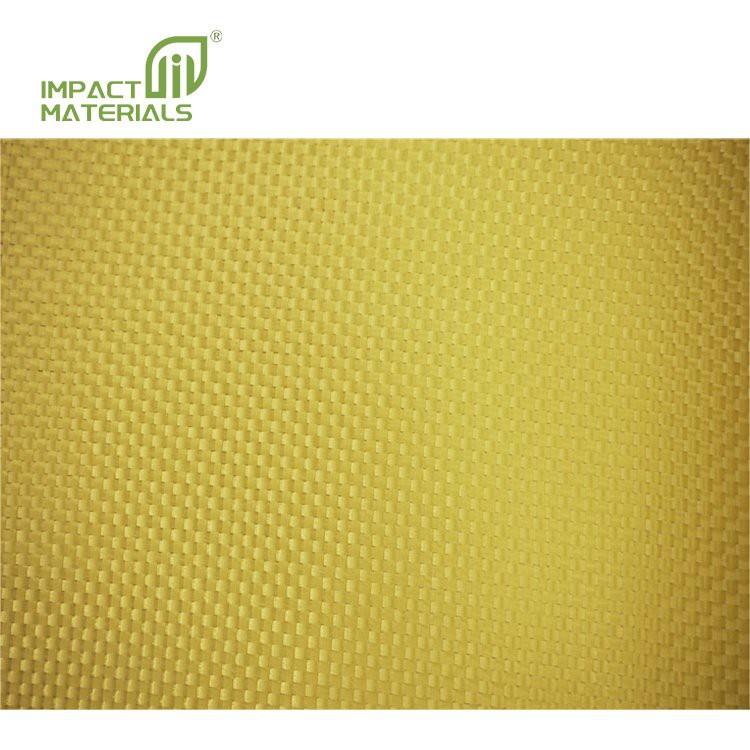
Kevlar Aramid Fabric for Bulletproof Vest
Para-aramid fabric woven for NIJ 0101.06 Level IIIA soft body armor panels. Available in plain and twill weave configurations with ballistic-grade certification.
NIJ IIIA Certified
Plain / Twill
View Full Specs →
Application Matching: Where Each Brand Delivers
The choice between Kevlar and Twaron is not abstract — it maps directly to specific application requirements, regulatory environments, and commercial constraints. Here is a practical matching framework.
Soft Body Armor (NIJ IIIA vests): Both brands perform identically when fabric construction is matched. Choose based on: (1) whether the tender specifies a brand name, (2) lead time availability, (3) your factory’s familiarity with the manufacturer’s construction guidance sheets. If your factory already has DuPont layup schedules calibrated, switching to Twaron requires a brief re-calibration period.
Aerospace Composites: Kevlar 49 has a 3–5% modulus advantage over Twaron 2200 at equivalent denier. For primary structural components where modulus is a certified design parameter (FAA/EASA qualification), Kevlar 49 may be specified. For non-structural fairings, interior panels, and secondary structures, Twaron 2200 delivers equivalent performance at lower cost.
Protective Clothing (PPE): Both brands work. Twaron’s lower filament friction makes it easier to knit into heat-resistant gloves and sleeves on standard circular knitting machines. Kevlar’s slightly higher modulus gives knitted garments marginally better cut resistance in ASTM F1790 testing. The practical difference is small; choose based on supplier proximity and pricing.
Friction Materials (brake pads, clutch facings): Short-cut aramid fiber for friction reinforcement does not need a specific brand — generic para-aramid short-cut from either source performs the same. Brand selection is irrelevant here; specify denier range, cut length, and surface treatment instead.
Automotive Reinforcement (tires, hoses, belts): Twaron is more commonly used in European automotive supply chains due to Teijin’s proximity to continental tire manufacturers. Kevlar dominates in North American automotive. This is a supply-chain geography decision, not a performance decision.
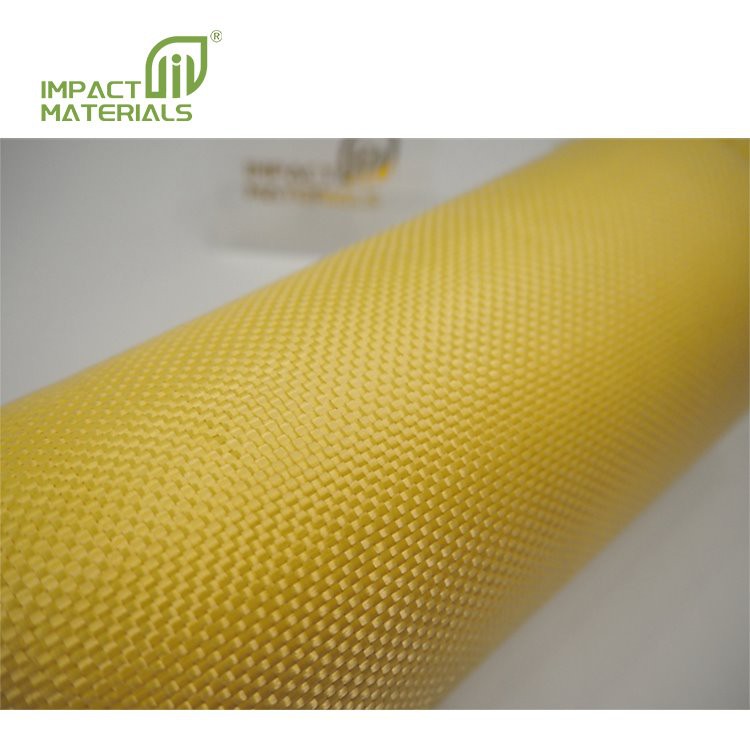
Aramid Woven Fabric
Multi-application para-aramid woven fabric suitable for ballistic protection, industrial reinforcement, and PPE. Compatible with both Kevlar and Twaron yarn sources.
150-460 gsm
Plain / Twill
View Full Specs →
Before You Choose Kevlar or Twaron: A Procurement Checklist
Frequently Asked Questions
Is Twaron as strong as Kevlar?
Yes. Both Kevlar 29 and Twaron 1000 show breaking tenacity between 20.0 and 21.0 cN/dtex per ASTM D7269 testing. The tensile difference is less than 2.5%, which falls within normal lot-to-lot variability. For ballistic applications, the two brands are functionally interchangeable when fabric construction is matched.
Which aramid fiber is better for body armor?
Neither is inherently “better” for body armor. NIJ 0101.06 certification is granted to the finished vest panel, not the raw fiber. A vest with 10 layers of 200 gsm plain-weave Kevlar performs the same as one with identical Twaron construction. The deciding factor is usually tender requirements, supplier availability, and whether your factory has calibrated layup schedules for the specific brand’s construction guidance.
Why is Twaron cheaper than Kevlar?
Twaron’s lower FOB pricing reflects Teijin’s production economics in the Netherlands and Japan, not a quality difference. Labor and energy costs in those regions, combined with lower tariff schedules for EU/Japan-origin imports to Asian markets, reduce Twaron’s landed cost in China by 10–15% compared to US-origin Kevlar.
Can I substitute Twaron for Kevlar in an existing vest design?
Yes, provided you recalibrate the fabric construction. Both brands use PPTA polymer, so the fiber class is identical. However, each manufacturer publishes its own construction guidance — DuPont’s layup schedules differ in format and layer count from Teijin’s. Your factory needs to run a qualification panel with the new brand and confirm NIJ compliance before switching production.
Do I need a trademark license to use Kevlar or Twaron on product labels?
Both DuPont and Teijin require trademark licensing agreements if you use “Kevlar” or “Twaron” on product documentation, marketing materials, or customs declarations. If you label products as “para-aramid fiber” or “para-aramid fabric” without the brand name, no licensing is needed. Check your buyer’s tender requirements — some government contracts specify the brand name on documentation.
Key Takeaways
- Kevlar and Twaron share PPTA polymer chemistry — their tensile performance differs by less than 2.5% and is functionally interchangeable for ballistic applications.
- The real differences are in supply chain: Twaron offers shorter lead times and lower landed cost in Asian markets; Kevlar has established construction guidance calibrated in US defense programs.
- NIJ 0101.06 certification applies to the finished vest panel, not the fiber brand — brand choice is a commercial decision, not a materials decision.
- Twaron’s lower filament friction coefficient reduces needle breakage during weaving, improving production efficiency for ballistic fabric manufacturers.
- Trademark licensing is required for both brands if you use the brand name on product documentation — specify “para-aramid” to avoid this requirement.
Request a sample → — Get physical samples of both Kevlar-based and Twaron-based para-aramid fabric to test on your production line before committing to a bulk order.